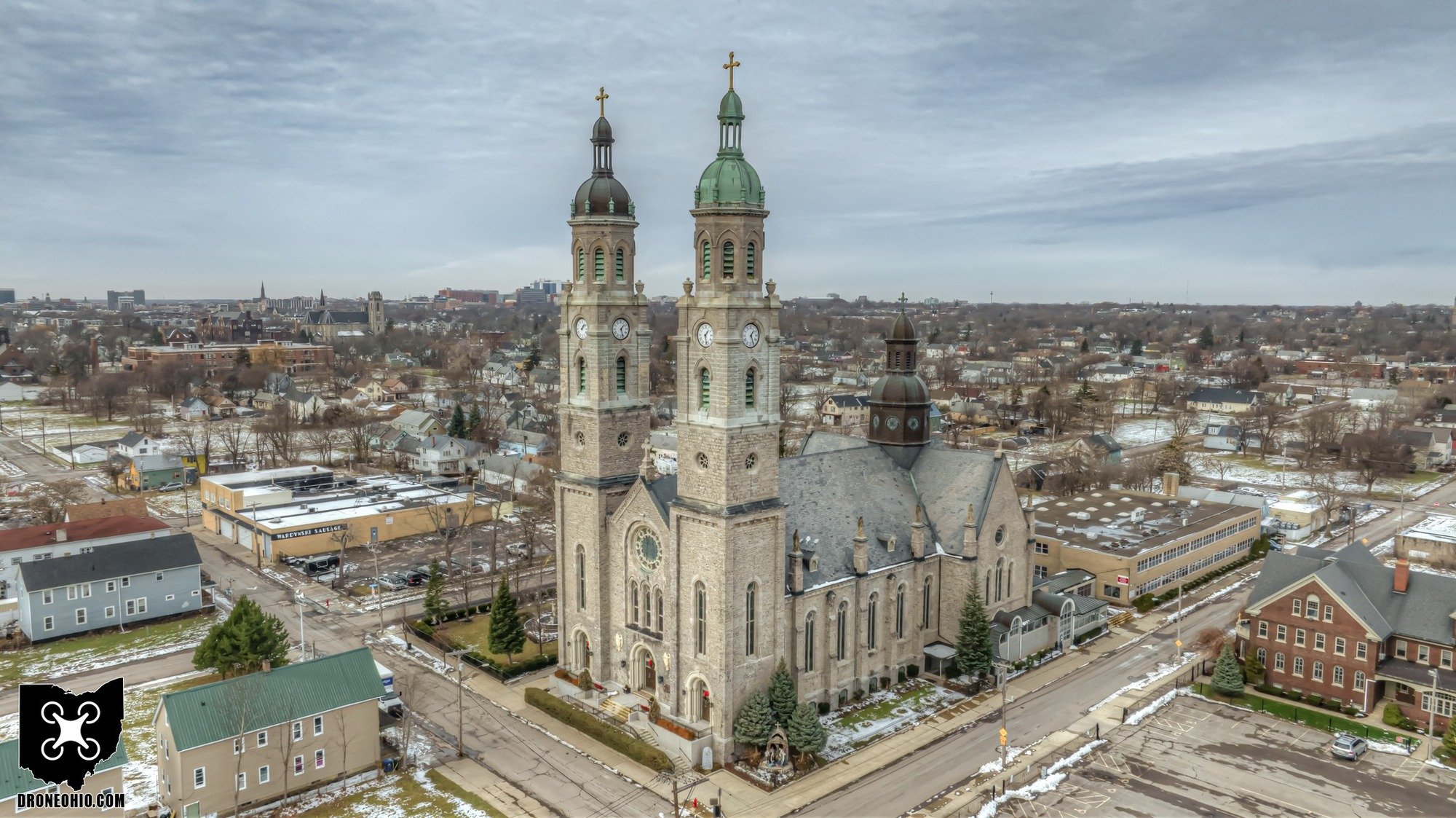
We cordially welcome to the Mother Church of Polonia in Buffalo - Saint Stanislaus Bishop & Martyr Parish.
O Lord, We lift our eyes to see your glory. We open our hearts to receive your love. We engage our minds to understand your truths. We offer our songs to praise your name. Lord, as we give you our lives, please take everything that we are, so that we may reveal your blessings in our Parish.
We have a lot of activities both spiritually and socially for parishioners of all ages.
Come join us!
Introduce yourself after Mass to The Pastor or stop by or call the rectory during the week.
Msgr. Peter Adamski Polish Saturday School at Buffalo is a Nonprofit organization that has been in operation since 1955 and has graduated thousands of students. Most of these students are of Polish descent whether it be first, second, third, fourth or greater generation.
Classes: The classes take place from September to May at St Stanislaus Parish in Buffalo, every Saturday from 10.30am until 1:00pm. We offer Polish language classes for children and adults at various proficiency levels.
The explosive growth of Buffalo, New York during the late 19th & early 20th centuries can be attributed to the historic influx of European immigrants to the region. The largest group to arrive during this period were the Polish. Escaping religions and cultural persecution as well as the quest for economic opportunities, Poles by the thousands arrived by railroad to Western New York.
Land for a Polish parish and school was donated by German landowner Joseph Bork in 1873. Under the leadership of pastor, Rev. Jan Pitass, Saint Stanislaus Bishop & Martyr Parish quickly became religious and social center for the second largest Polish-American colony in North America. The parish holds the distinction of being the oldest Polish parish in New York State.
The parish’s original wood framed "country" church was soon became inadequate for the vast increase in population. In 1882, parishioners embarked on on the construction of the current church. Work was begun in 1883 on a design provided by architect T.O. Sullivan. In 1886, the iconic structure was dedicated.
The massive Romanesque building which is still standing today, is 192 feet in depth and 104 feet wide, is built of Jammerthal flint stone with Lockport limestone trim. The building’s two towers were completed in 1908.
Prior to 1870, a small community of Poles resided within the city. Centered in the area of Broadway and Sycamore between Pine and Walnut Streets, they numbered only around 150 people total. These immigrants, the majority of who were aristocrats and professionals, were drawn here by the sense of adventure the New World promised them. By 1873, this community had grown to include 500 people.
The majority of the immigrants did not stay in Buffalo longer than a few days, instead opting to travel further west to the already established Polish communities in cities such as Chicago and Detroit.
Joseph Bork, owner of a vast tract of land bounded by Smith and the Belt Line Railroad, and Howard and Broadway recognized this trend. Noticing that the Polish communities in other cities were centered around a house of worship, he felt that more would stay here if they too, had a house of worship they could call their own. Aspiring that his property serve as a newly developed Polish Community, he donated a tract of land on Peckham Street to the Diocese of Buffalo, intending it to be the location of a new Polish parish.
In December, 1872 Rev. Ivaneff Marie Gartner began a series of Polish services at Saint Michael's Church. Upon the conclusion of this work, he advised the Poles attending to organize as a congregation, thus forming the roots of Saint Stanislaus parish. The following year, Bishop Ryan ordained John Pitass as a Catholic Priest. He celebrated his first mass for the Polish people of what had become to be known as the Saint Stanislaus Society.
With a parish organized, Polish people passing through the city on their way west were given an impetus to stay. By January, 1874 Rev. Pitass had completed the first building for St. Stanislaus thus initiating the colonization of the East Side by Polish immigrants. Wishing to make the most of the opportunity, Bork immediately began constructing homes in the southwest corner of his holdings. Within three months, he had completed almost 400 single story frame homes in the area bounded by Smith, Fillmore and William Streets, By 1876, the majority of the Poles residing in the Pine Street area had moved into homes here.
Following an initially slow period of growth from 1873 to 1877, the number of Poles arriving in the area increased dramatically. Drawn to the community formed within the shadows of St. Stanislaus Church, their numbers increased almost exponentially.
In January, 1879, 2,500 Poles resided in the area, a number which increased to 3,500 by December. With those already here writing home and telling of the prosperity of the city, their numbers increased to 5,500 by 1880 and to 9,500 the following year.
This large influx of people initially resulted in a few problems for the area. As many Poles would send money to their relatives in the homeland to pay for passage to the united States, they initially could not secure a strong financial foothold here. The problem was only compounded by the arrival of people from the homeland and the added financial burden placed upon the families here.
To ease the mounting problems and assist in the transition to life in the New World, the city arranged for the former army barracks on Fillmore Avenue near Paderewski to be opened as an temporary living quarters for the immigrants.
In the 1880s, Bork began constructing two story homes, thus providing a source of income for owners who elected to rent out a portion of their building. This added income enabled the majority of the homeowners to pay for their property within two years of purchase.
The period of 1884-1888 saw the largest influx of Poles arriving to the city with peasants, seeking an improved economic climate in the States, constituting the majority of these arrivals. By 1890 over 20,000 Poles resided in the Polish East Side on land which twenty years previous had been undeveloped. By 1910, the colony grew to nearly 100,000.
With additional immigrants arriving, conditions within St. Stanislaus became exceedingly crowded resulting in the establishment of other Polish Roman Catholic parishes. In 1886 St. Adalbert's parish became the first new congregation to be formed out of the parish boundaries of St. Stanislaus. The diocese located the house of worship north of Broadway in a relatively unsettled area. Consequently, to keep pace with the high demand for housing in the vicinity of the new parish, during the course of that year, Bork constructed 300 homes adjacent to the church and an additional 800 the following year.
Polonia, the East Side enclave of what was one of the largest Polish communities in the United States, is a pure demonstration of the power of the house of worship in establishing a distinctly cohesive neighborhood. It also constitutes the only neighborhood in the city where Catholicism reigns supreme. Out of the thirteen religious buildings remaining, only two were not affiliated with Catholicism. (“Polonia” - Joseph Bork & St. Stanislaus Church by Hames Napora)
1872 St. Stanislaus Society was organized. 1873 John Pitass arrived in Niagara Falls. 1873 Rev. John Pitass was ordained. 1873 Rev. John Pitass met with the St. Stanislaus Society which organized the formation of St. Stanislaus Parish. 1873 Cornerstone of the wooden church was blessed. 1874 The first church which was located on the corner of Peckham and Townsend Streets was dedicated by Bishop Ryan. 1874 St. Stanislaus School was opened. 1881 Felician Sisters brought to St. Stanislaus. 1882 Ground-breaking and construction of the new and larger church began. 1883 Cornerstone of the new church was blessed. 1883 Lower church was completed and opened for services. 1886 The upper level of the church was completed. 1886 St. Stanislaus Church was officially blessed by His Excellency, Bishop Borgess of Detroit. 1889 St. Stanislaus Cemetery was opened. 1890 The new 4 story school which was located at the intersection of Fillmore and Peckham was dedicated. 1893 Johnson Pipe Organ installed. 1894 Rev. John Pitass received the honor title of - “Dean”. 1903 Rev. Msgr. Alexander Pitass was ordained. 1908 The steeples and bells were installed. 1913 Dean John Pitass died. 1914 Rev. Dr. Alexander Pitass was installed as the 2nd Pastor. 1915 Rev. Msgr. Peter J. Adamski was ordained. 1916 Carrara marble altar was installed and consecrated by Bishop Dougherty. 1930 Additional stained glass windows added. 1944 Rev. Dr. Alexander Pitass died. 1944 Rev. Stanislaus Kulpinski was named Administrator of the Parish. 1945 Rev. Msgr. Peter J. Adamski became the 3rd Pastor. 1948 Rev. John R. Gabalski was ordained. 1953 Interior of church simplified. 1954 Renovation of Johnson Pipe Organ. 1960 Msgr. Peter J. Adamski Social Center was built. 1971 Old St. Stanislaus School was torn down and moved to new location (former Bishop Colton High School). 1971 Rev. Edward M. Grosz was ordained. 1974 Rev. Msgr. Peter J. Adamski retired. 1974 Rev. Msgr. Chester A. Meloch became the 4th Pastor. 1978 Rev. Msgr. Chester A. Meloch retired. 1978 Rev. Msgr. John R. Gabalski became the 5th Pastor. 1982 Rev. Msgr. Peter Adamski died. 1998 St. Stanislaus Parish celebrated its 125th Anniversary. 2003 Rev. Msgr. John R. Gabalski died. 2003Bishop Edward M. Grosz, D.D., V.G.became the 6th Pastor. 2004 Eight (8) new acrylic illuminated clocks were installed. 2004 Restoration project of the historic organ began. (Completion date: September, 2005) 2004 Illumination of the church towers. 2004 - 2005 Extensive restoration / renovation of parish facilities (Rectory, Convent, Msgr. Adamski Center, Msgr. Pitass Center, Parish School and Church). 2009 -2015 A native of Poland, Pastor Thaddeus Bocianowski assumed leadership of St. Stanislaus Church in 2009 and provided leadership until April 2015 2015-2018April 2015, Fr. Mariusz Dymek, a native of Pila, Poland, became the 8th pastor of St. Stan's. 2018 September 1, Fr. Tomasz Piotr Wilk OSPPE, a native of Sosnowiec, Poland, became the 9thPastor of St. Stan’s 2019 Fr. Michał (Michal) Czyżewski, OSPPE, became the 10th pastor of St. Stans 2022 Father Mariusz Dymek, OSPPE, named administrator (while remaining the pastor of Corpus Christi) 2023 St. Stan's become part of the Greater East Side Family of Parishes along with St. John Kanty, St. Katharine Drexel, St. Adalbert, and St. John Gualbert. 2023 Fr. Cole Webster is named the 11th pastor of St. Stan's and the the moderator of the Greater East Side Family of Parishes
Rev. Dean John Pitass Founder of St. Stanislaus B.M. Parish. He was ordained on June 7, 1873 at Niagara University and immediately establish the parish. He remained as Pastor until his death on December 11, 1913.
Rev. Alexander Pitass, D.D. Second pastor and nephew to Dean Pitass. He was educated and ordained in Rome in 1903 , and was appointed pastor on January 12, 1914. He died on June 30, 1944.
Rev. Peter J. Adamski, P.A. came from Poland in 1909 and completed his studies at St. Bonaventure University. He was ordained on June 10, 1915 and became pastor of St. John Gualbert in 1918. Adamski became pastor of St. Stanislaus on July 2, 1945 and remained as leader until December 8, 1973. He passed away on September 21, 1982.
Msgr. Chester A. Meloch served as pastor from January 5, 1974 to February 1, 1978. He was the first pastor to be baptized at St. Stanislaus. He was ordained on September 21, 1943. One of the highlight's of Meloch's years at St. Stan's was the visit by President Gerald Ford on Oct. 31, 1976.
The beloved Msgr. John R. Gabalski was assigned pastoral leadership of St. Stanislaus in 1978 and served the parish until his passing on October 9, 2003. He was ordained on May 22, 1948. Prior to joining St. Stan’s, Gabalski was pastor of Queen of Peace. His tenure witnessed visits by Karol Cardinal Wojtyla (later Pope John Paul II) and President Lech Walesa of Poland. Accomplishments of the Msgr. Gabalski administration included the construction of both the Msgr. Adamski Apartments and a housing project which became Pope John Paul II Court, the construction of the Marian Mausoleum at St. Stanislaus Cemetery, a building for the parish Outreach Center, and a host of social and spiritual enhancements including a 125th year parish anniversary gala.
On October 21, 2003, following the death of Msgr. John Gabalski, Bishop Edward M. Grosz was assigned as the 6th Pastor of St. Stanislaus Bishop and Martyr Parish. Grosz guided a multi-million dollar renovation of the entire St. Stanislaus Parish campus. Bishop Grosz served St. Stanislaus until December 1, 2009.
A native of Poland, Pastor Thaddeus Bocianowski assumed leadership of St. Stanislaus Church in 2009 and provided leadership until April 2015.
April 2015, Fr. Mariusz Dymek, OSPPE, a native of Pila, Poland, became the 8th pastor of St. Stan's.
Fr. Tomasz Piotr Wilk OSPPE, a native of Sosnowiec, Poland, became the 9th Pastor of St. Stan's
Fr. Michal Czyzewski, OSPPE, a native of Opoczno, Poland became the 10th Pastor of St. Stan's
Fr. Cole Webster became the 11th pastor of St. Stan's when he became the pastor and moderator of Family of Parishes #30 (Greater East Side Family of Parishes) in 2023
In 1893 the parish purchased Op. 797 from Johnson & Son of Westfield, Massachusetts for $7,875.00. Charles Viner of Buffalo installed the instrument. Viner was frequently connected with Johnson installations throughout the region. In 1954 the parish commissioned the Tellers Organ Company of Erie, Pennsylvania, along with Tellers’ representative, Stephen Po-Chedley & Son of Buffalo, to renovate the instrument as their Op. 814. (Charles Viner & Son of Buffalo had also submitted a bid that May, in the amount of $19,957.00.) The organ was dismantled, and pipework was taken to Erie for cleaning and repair. The mechanism was new throughout, including new wind system, wind-chests and stop-key-style console. The Choir division was placed under expression. During the course of the project, several ranks were added and a few new stops unified; the Johnson facade was retained. Restorative work was carried out in 1979 and 1993.
In 2004, under the guidance of Bishop Edward M. Grosz, D.D., 6th pastor of St. Stanislaus Bishop & Martyr Parish, another major restoration has begun. Included in the restoration will be additions to the organ, a new console and gilding of the pipes bringing the replacement value today to over 1 million dollars.
St. Stanislaus Roman Catholic Cemetery has served the needs of parishioners and the greater Buffalo area since 1889. The cemetery is located at 700 Pine Ridge Heritage Blvd., Cheektowaga, New York. Masses are celebrated on the following occasions at the Resurrection Mausoleum and the Marian Mausoleum. Mother’s Day Memorial Day Father’s Day Christian Holocaust Mass(closest Saturday to St. Maximilian Kolbe) All Souls Day For more details regarding these Masses feel free to contact the cemetery office at (716) 892-9135.
“Over a century of service with respect and dignity”